
On this page
Ultimate B2B SEO Guide: Boost Revenue with Organic Search

Wanna win with B2B SEO?
This comprehensive guide helps B2B SaaS, service, and tech companies generate sustainable revenue through organic search, creating a consistent pipeline of leads, consultations, and demo requests.
Common problems I see with B2B companies
Neglecting organic SEO
Many B2B firms prioritize paid advertising and outbound sales while overlooking organic search potential, missing significant market demand opportunities.
Lack of content on B2B websites
Websites often contain minimal content with only a few pages, limiting prospect visibility and reducing credibility in the marketplace.
Undervaluing SEO
Companies fail to recognize SEO’s importance in driving organic traffic and generating leads, potentially losing access to wider audiences.
Pressure to achieve fast revenue targets
Investor pressure for quick revenue often leads organizations to neglect long-term digital marketing strategies, including comprehensive SEO efforts.
Why invest in SEO?
“It enables you to establish a lasting organic content ecosystem that consistently ranks on Google, generating inbound leads even while you sleep.”
SEO creates an organic inbound engine positioning your company prominently when potential clients search for industry information or engage with sales processes. This approach also reduces excessive advertising spending while building sustainable growth.
What you’ll need before investing in SEO
Before implementing SEO, ensure your website features:
- Effective design that attracts your target audience
- Mobile and desktop optimization
- Compelling messaging that resonates with prospects’ needs and goals
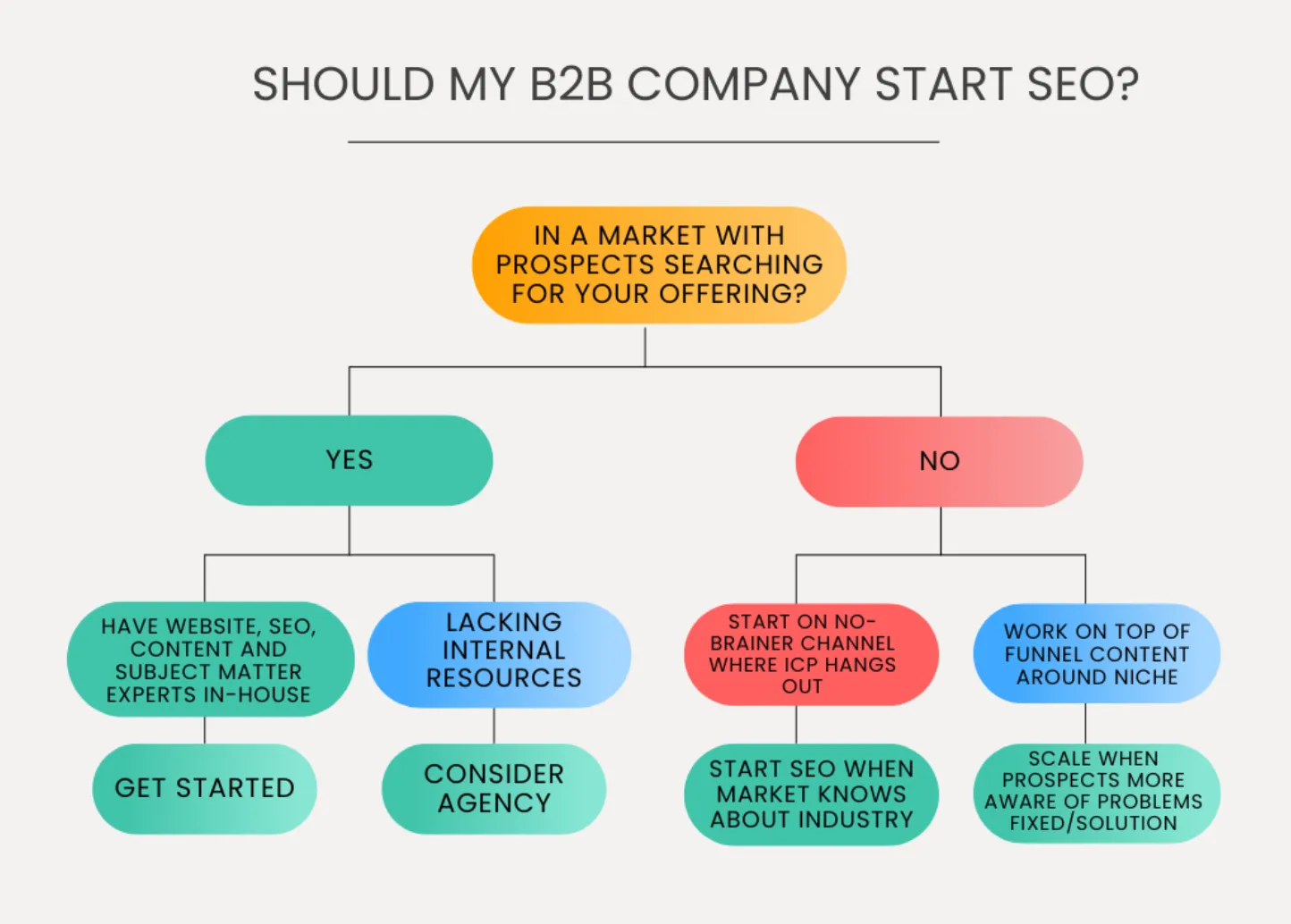
Not sure if SEO is a good fit?
Unless you operate in a brand-new or highly niche market, SEO is essential for establishing online presence and maintaining competitiveness. This long-term strategy delivers substantial results for companies seeking to increase brand visibility and drive organic revenue growth.
Keyword research
Out with the old-school
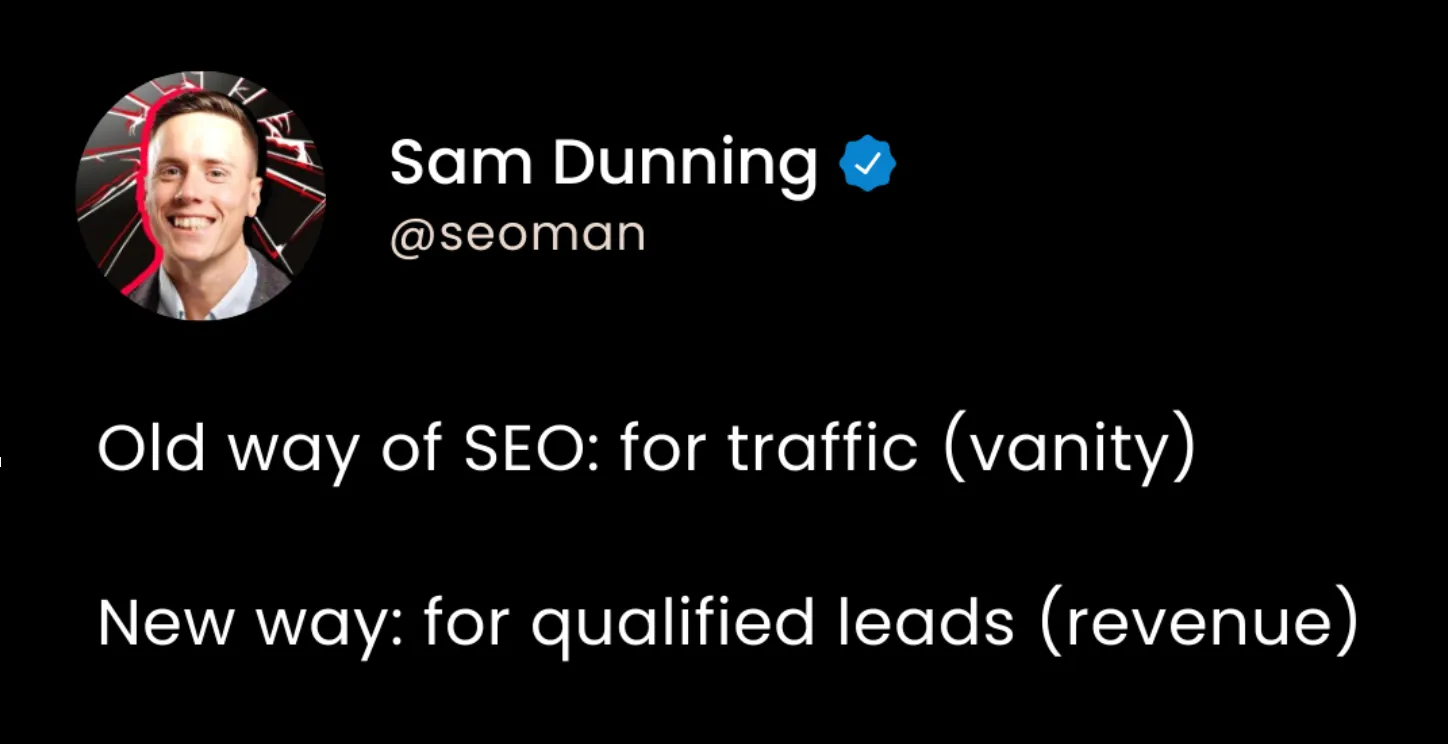
Revolutionary keyword research prioritizes insights from ideal clients and prospects over solely relying on software tools. Your target customers represent the ultimate source of powerful search terms and content ideas.
Engage directly with prospects to uncover:
- Pressing questions they frequently ask
- Common objections they encounter
- Key challenges they face
Collaborate with your sales team to compile a comprehensive list of common queries and obstacles. Tools like Gong help dissect sales calls, revealing what customers desperately need answers to. This customer-centric approach ensures your keyword strategy addresses real market demand.
More traditional keyword research
After building your customer-informed list, conduct traditional keyword research focusing on high buying intent searches relevant to your offerings. For example, if targeting sales teams, focus on keywords like:
- “Proposal software”
- “Sales recording tools”
- “Buyer enablement software”
Long-tail keywords harbor hidden opportunities. More tailored keywords targeting specific niches and audiences generate faster rankings and attract higher-quality leads.
Instead of competing for generic terms like “CRM,” target specific variations such as “CRM software for accounting.” Long-tail keywords expedite rankings and attract high-quality leads from desired markets.
Popular SEO keyword research tools
- Semrush
- Ahrefs
- Google Keyword Planner
- Ubersuggest
Other ideas for keyword research
- Problem-based searches: Target keywords addressing audience pain points or challenges.
- Competitive comparisons: Use searches like “[your brand] vs [competitor]” to attract decision-stage users.
- Answer-focused queries: Optimize for “how to do X?” to capture solution-seeking users.
- Sales funnel coverage: Tailor keywords for each stage, from learning and evaluating to searching for solutions.
- Alternative searches: Target terms like “Calendly alternative” or “Chili Piper alternative” to reach comparison shoppers.
- High-intent queries: Optimize for “Best [offering] tool/company/software” to attract users seeking top solutions (typically listicle formats with 10+ results).
- Zero traffic searches: Capitalize on overlooked terms with high intent, answering common questions about audience-specific problems. These attract quality leads with minimal competition.
On-page SEO
On-page SEO encompasses optimization efforts directly on your website to improve organic search rankings. This includes technical aspects like site structure and content optimization, aiming to enhance visibility and relevance for specific keywords while attracting more organic traffic.
Technical SEO
A comprehensive audit should focus on:
- Page speed: Ideally 2 seconds or less
- Key data tools: Implement relevant SEO tools and tracking
- Google Analytics: Track traffic sources, organic traffic, and conversions
- Search Console and Google My Business: Enhance visibility
- Competitive analysis: Identify benchmarks and surpass them
- Metadata revision: Update title tags and meta descriptions on core pages
- SEO landing pages: Develop pages targeting key search terms
- Internal linking strategy: Create a clear site structure with relevant links
- Rich snippets and schema: Implement structured data
- Technical issues: Address keyword cannibalization (multiple pages ranking for same keyword)
- Image optimization: Optimize filenames, alt text, and title attributes
Website content
Create dedicated pages for:
- Each feature and target market
- Key personas and use cases
- Competitor alternatives
- Integrations
- Any terms potential customers may search for
Focus on high buying intent search terms and develop pages aligning with search intent.
A simple page-building strategy: analyze the top 3 organic results for your target keywords. This reveals practical strategies for attracting prospects.
Step 1: Content development
Develop service, product, or article pages tailored to target audiences, addressing:
- Client concerns and challenges
- Objections and aspirations
- Google’s E-E-A-T update (Experience, Expertise, Authority, Trust)
For solution pages, include:
- Overview of the offering
- Common problems it addresses
- Why it matters
- Process walkthroughs with video guides
- How-to guides
- Examples or case studies
- Pricing information
- FAQs
- Social proof (testimonials, videos, reviews)
- Clear calls to action
Built a page but it’s not ranking?
The issue often involves missing search intent. Search intent represents what potential customers seek when searching, whether researching, comparing options, or ready to purchase.
For example, ranking for “best meeting scheduling software” competes against comparison articles dominating the first page.
A smarter approach:
- Study the top 3 organic results.
- Determine the content format (article, listicle, solution page, comparison page, or unique format).
- Create an outstanding page that surpasses the competition.
- Back it with customer insights connecting to prospects.
- Position your product as the ultimate choice.
Step 2: Design and technical elements
Create solid mobile and desktop designs incorporating:
- Meta titles and descriptions
- Image and heading tags
- Relevant internal links
- Essential technical SEO elements
Step 3: Scale across your portfolio
Apply this process across all high-intent money search terms and services.
After exhausting high-intent search terms, craft blog articles addressing pressing client questions related to your core services. Remember: your clients hold valuable insights shaping successful content strategy.
Quick wins for B2B SaaS and tech companies
Master these high-converting keyword categories before pursuing random blog articles:
Best [category] software
Format: listicle. Create a more comprehensive and helpful list than current #1 rankings. Include fair competitor summaries, position your brand first, highlight the problems you solve, explain how you solve them, and include clear CTAs. Build variations for each offering (software/tool/platform).
Your brand vs competitor
Similar listicle format, more narrowly focused on your company versus core competitors. Build pages for each main alternative.
Competitor alternatives
Comparable to the “Best [category] software” approach with listicle intent. Rank for users comparing alternatives.
Best [tool/software] for [industry]
Map the key industries driving profitable clients. Develop long-form pages for every key offer × industry combination.
How to [job to be done]?
Framework: Jobs To Be Done (JTBD). This framework begins with customer interviews, specifically from people recently making changes (new customers).
Understanding why they made changes matters more than what they bought. The critical insight: the moment customers realized they couldn’t progress without changing solutions. That tipping point represents your marketing gold.
From customer interviews, identify:
- How prospects previously accomplished the job
- The painful problem forcing them to change (the “bleeding neck problem”)
Leverage this framework:
- Identify the JTBD.
- Describe the problem with previous approaches.
- Explain the consequences of ignoring it.
- Position your offer as the solution.
Keyword research integration: research how prospects previously solved problems before your solution existed. Target others with similar struggles searching Google.
For a power dialer SaaS tool, target searches like “how to make faster cold calls with a cell phone.” In your article, apply the framework: highlight manual dialing problems, discuss impact (slow dials, fewer conversations), and present your power dialer as the solution.
Off-page SEO
Off-page SEO encompasses strategies executed outside your website to boost online visibility. This becomes critical when targeting competitive and generic keywords.
Backlinks are powerful signals. Google perceives backlinks as credibility testimonies, boosting domain authority and organic ranking potential, even for challenging keywords.
Free backlink building methods
Podcasting
- Visit podcast ranking sites (chartable.com) and navigate to charts.
- Select Apple as the platform and choose your target audience country.
- Pick a service category matching your expertise.
- Explore top 100 podcasts in the chosen category.
- Identify podcasts accepting guest appearances.
- Craft personalized outreach emails to hosts.
- Participate in engaging episodes, subtly promoting your brand.
- Request backlinks on podcast article pages post-release.
Monthly consistency yields valuable backlinks and enhanced credibility among target audiences.
Outreach
Create standout articles addressing your niche. For example: “How to Choose the Best Finance CRM.”
After publishing, search Google for topic rankings and analyze top first-page results. Elevate your content by focusing on:
- Demonstrating industry expertise
- Enhancing content quality and quantity (aim for 10k+ words)
- Incorporating unique stats and data
- Including visually appealing infographics
- Using video explainers
- Covering all aspects thoroughly
- Providing actionable insights
- Embracing the ‘Skyscraper’ technique
Once ready, reach out to relevant companies and influencers mentioned in guides for potential backlinks. A top-notch article naturally attracts backlinks over time.
Partnerships
Discover businesses providing complementary services. For example, web design and SEO agencies might partner with analytics software companies.
Collaborate on engaging content (guides, how-tos, videos, podcasts) and cross-promote on respective blogs. This strengthens relationships while boosting SEO efforts.
Guest articles
Reputable websites welcome industry-specific guest contributions. Success maximizes by:
- Seeking established sites aligned with your field
- Reviewing submission guidelines
- Proposing valuable content
Search “[your industry/keyword + write for us]” or “[your industry/keyword + guest article].” Approved contributions typically permit backlinks in featured author sections.
HARO sites
Use HelpAReporterOut.com to stay updated on news and media stories. Connect with journalists responding to requests. Selected responses earn valuable news site backlinks.
Paid backlink building methods
- Buy backlinks from trusted editorial websites.
- Partner with agencies handling comprehensive SEO and link building.
- Redirect energy toward business expansion and lead conversion.
- Avoid cheap link building services promising unrealistic results (risk of penalties).
- List your website on industry-relevant directories and citations with backlinks.
Using video in SEO
Strategy: create comprehensive YouTube videos centered around target search terms, then embed them in related articles or pages.
Benefits:
- Optimized pages achieve higher rankings.
- Video thumbnails boost click-through rates.
- Pages climbing rankings may display in both organic and video sections simultaneously.
This dual-position strategy dominates competitive keywords and has proven successful for various services.
Getting stakeholder buy-in for SEO
SEO can be challenging to sell internally. Here are three valuable tips for navigating organizational buy-in:
Tip 1: Address C-suite pain points
While effective SEO shows inbound pipeline impact within three months, this may not convince leaders. Instead, emphasize their concerns:
“Whenever a prospect searches for our solution, problems we solve, or compares us to competitors, our competitors come out on top, robbing us of potential leads.”
Starting SEO sooner unlocks sustainable inbound traffic through organic search, especially in established, in-demand sectors.
Tip 2: Leverage evergreen content power
Introduce the SEO secret weapon: evergreen content continuously attracting traffic and leads for years.
Consider these use cases:
- Pages showcasing core offerings for sale
- Articles answering common questions
- Competitor comparisons
- Solutions to urgent problems
- Overcoming sales objections
Well-optimized SEO content maintains lasting impact. While paid advertising has benefits, organic search results inspire user trust. Users perceive these as earned, not bought.
Tip 3: Show results immediately
Leverage Google Analytics, Search Console, CRM dashboards, sales call recordings, and more to extract valuable data. Capture positive screenshots, store them in Google Drive, and share via Slack or email to showcase real-time developments.
Key reporting focus areas:
- Monitor focus keyword ranking gains and organic traffic increases.
- Analyze session durations from organic inbound leads.
- Note demos and conversions sourced from SEO.
- Review sales call recordings where prospects discovered your business via Google.
- Highlight successful deals and revenue generated from SEO-driven channels.
- Consider adding “how did you hear about us” fields to lead forms.
B2B website tips
Many sales teams harbor frustration toward company websites. Sites often prioritize quantity over quality, resulting in unqualified leads that waste everyone’s time.
These tips ensure your website sparks valuable conversations driving revenue growth:
Share your offerings
For SaaS: include live demos, videos, and GIFs showing product functionality before call scheduling.
For service providers: showcase project case studies with walkthroughs.
Educate
Multiple educational approaches:
- Podcasts
- Playbooks
- Video guides
- Helpful articles
- FAQs on key pages
Identify the main client questions, issues, problems, and tasks. Address these directly on relevant pages and resource sections. When prospects arrive equipped with knowledge and valuable assets, it boosts confidence and streamlines sales.
Qualify
A 2024 B2B essential: display pricing prominently.
Show main tiers or starting price ranges. Demonstrate value through customer success stories. Address common pricing questions upfront. Be transparent about who you can and can’t help. Discuss your delivery process.
Results
Replace PDF attachments disappearing into junk folders with solid social proof:
- Case studies
- Video testimonials
- Client reviews with photos
- LinkedIn or social media comment screenshots
General copy
Avoid fancy vocabulary unless your customers actually use industry-specific terminology.
Ensure content addresses:
- Problems you solve
- How you solve them
- What sets you apart
- Business and life benefits
- Consequences of not choosing your service
Customer research transforms this section.
Calendar booking
Replace back-and-forth enquiry forms with integrated scheduling calendars on demo and call pages. This streamlines the booking process and improves user experience significantly.
Final thoughts
For well-established industries where target audiences already know about your product or service, a strong SEO strategy boosts website traffic without ad spending.
SEO represents jackpot potential for increasing organic traffic and attracting inbound leads while building brand credibility. It complements other marketing efforts like demand generation, outbound sales, and more.
Stay at the top of search results and watch your business grow.