On this page
- Why listen to us
- What “ranking on ChatGPT” really means
- How to rank on ChatGPT
- 1. Learn how ChatGPT sources answers, then build your prompt set
- 2. Make your content easy for an LLM to lift
- 3. Clear the technical bar so you’re eligible at all
- 4. Build the off-site brand presence that does the heavy lifting
- 5. Publish content worth citing
- 6. Track mentions, citations, and share of voice
- ChatGPT ranking FAQs
- Where to start this week
How to Rank on ChatGPT: The 2026 Playbook for B2B

Your buyers are asking ChatGPT which tool to pick before they ever land on your site, and a lot of what shows up in those answers comes from Reddit threads, review sites, and roundups you don’t control. On ChatGPT there’s no fixed position to climb to. What matters is how often you get mentioned when someone asks.
More than 900 million people use ChatGPT every week as of early 2026, up from 400 million a year earlier (TechCrunch), and a big share of them are B2B buyers running research they used to run on Google. This guide covers how ChatGPT decides who gets named and the exact order to work through it:
- Learn how ChatGPT chooses sources, then build a prompt set to track where you stand
- Format your pages so an LLM can lift the answer cleanly
- Clear the technical bar so you’re eligible to be pulled at all
- Build the off-site brand presence that does most of the heavy lifting
- Publish the kind of content that earns citations
- Measure mentions and share of voice, then close the gaps
Why listen to us
We got RB2B ranked number one in both Google and ChatGPT for “Leadfeeder alternatives,” a buying-intent search that puts them in front of people actively shopping for what they sell. Proposify saw a 91% jump in visitors from AI search and a 115% lift in demos. MarqVision climbed in AI-search visibility inside six weeks.
Getting B2B software cited in AI answers is the whole job at Breaking B2B, and you can see more of those results here. That’s the exact problem this guide is about: turning ChatGPT from a place you don’t appear into a place that sends you demos.
What “ranking on ChatGPT” really means
Start here, because the word “rank” sets the wrong expectation. There’s no page two of ChatGPT and no fixed slot you can climb to. Ask ChatGPT for the best CRM ten times and you can get ten slightly different lists.
Rand Fishkin’s team ran 2,961 prompt tests and found that repeating the same question gives you well under a one-in-a-hundred chance of an identical answer twice (SparkToro). So the goal is your mention rate: how often you show up when a buyer asks a question you care about.
To improve that, you need to know where the answers come from. ChatGPT pulls from two different places.
The first is its training data, the giant snapshot of the web the model learned from. This is why a brand that shows up everywhere across the internet gets named even without live browsing. It’s also why this layer moves slowly. You can’t edit the model’s memory this quarter.
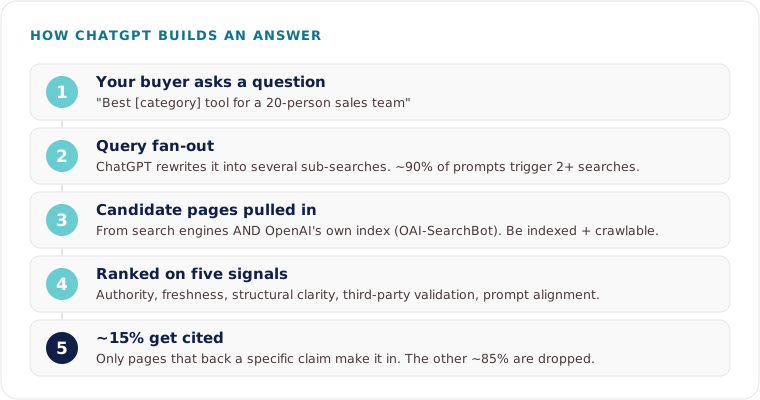
The second is live retrieval, which kicks in when ChatGPT searches the web to answer you. This is the layer you can actually influence in weeks. ChatGPT breaks your question into several smaller search queries, a process called query fan-out, runs them against a search index, and pulls back a pool of candidate pages.
AirOps analyzed 548,534 pages across 15,000 prompts and found roughly 85% of the pages ChatGPT retrieves never get cited (AirOps). The model only quotes a page when it directly backs a specific claim in the answer it’s writing.
Two facts about that pipeline change how you should spend your time.
First, ChatGPT finds those candidate pages the way any search does, with one twist. It expands your question into several searches, pulls results from search engines, and increasingly leans on OpenAI’s own index, built by its OAI-SearchBot crawler, which has tripled its crawl of the web since 2025 (Botify). Roughly 90% of prompts trigger two or more of these searches before you get an answer (Search Engine Land). The entry ticket is simple: your pages have to be indexed and crawlable, and OpenAI’s bots have to be allowed to reach them.
Second, your Google ranking barely predicts your ChatGPT citations. Ahrefs looked at 15,000 queries and found only about 8% of the URLs ChatGPT cites also rank in Google’s top 10 (Ahrefs). Google rankings still help, and ranking first there is a related job with different winners. This is why AI search has become its own discipline that now runs side by side with your core B2B SaaS SEO.
How to rank on ChatGPT
1. Learn how ChatGPT sources answers, then build your prompt set
Before you change a single page, figure out where you stand. You can’t improve a mention rate you’ve never measured, and guessing which questions matter is how teams pour effort into prompts no buyer actually types.
Start by writing down the real questions your buyers ask ChatGPT. Not keywords, full questions, in natural language. Think in four buckets:
- Category questions: “what’s the best [category] software for [use case]”
- Comparison questions: “[you] vs [competitor],” or “[competitor] alternatives”
- Brand questions: “is [your product] good,” “what do people think of [you]”
- Problem questions: the pain your product solves, phrased the way a buyer would (“how do I stop wire fraud at closing”)
Aim for 20 to 50 of these. That’s your prompt set, and it’s the single most useful asset you’ll build in this whole process.
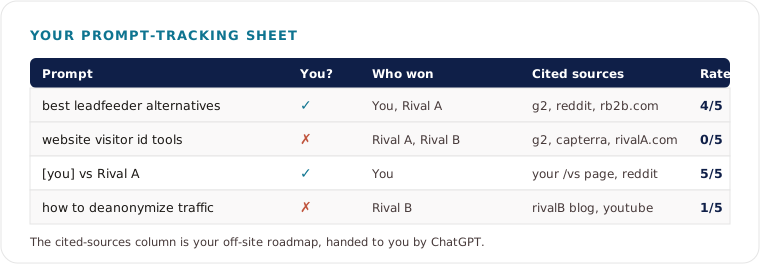
Now run each one through ChatGPT and log what happens in a simple spreadsheet. Record the prompt, whether you got mentioned, which competitors got mentioned, and which URLs ChatGPT cited. Because answers vary, run each prompt three to five times and record the frequency you appear across those runs. That frequency is your baseline visibility.
Fishkin’s research is the reason for the repetition. A single run is noise, and the pattern across runs is the signal. We walk through this same prompt-tracking build in our guide to ranking in ChatGPT search for B2B SaaS.
While you’re in there, check the sources ChatGPT cites for the questions where a competitor wins and you don’t. The same handful of domains show up over and over: a G2 category page, a Reddit thread, two or three “best [category] tools” roundups, maybe a Wikipedia entry. Write those down. That list is your off-site roadmap for step four, handed to you by ChatGPT itself.
One check to run now so step three isn’t a surprise: confirm your key pages are actually indexed. Type a site:yourdomain.com search into Google and Bing and make sure your important pages show up. If they’re missing from the search engines’ indexes, they can’t be pulled into an answer, and everything else you do is capped until you fix it.
2. Make your content easy for an LLM to lift
ChatGPT doesn’t read your page and admire it. It grabs the specific chunk that answers the question, a paragraph, a bullet list, or a table row, and drops that into its answer. So the practical question for every page is simple: can the model find a clean, self-contained answer it can lift without editing?
The move that matters most is to lead with the answer. Right under a heading that matches the question, put a direct 40-to-60-word response that stands on its own.
Search Engine Land’s audit of cited content found that most cited passages were short, question-framed, and answered the query in the first breath, and that 91% of them had no links inside the answer itself (Search Engine Land). Links inside the answer chunk seem to work against you, so keep the citation-worthy sentence clean and save your internal links for the sentences around it.
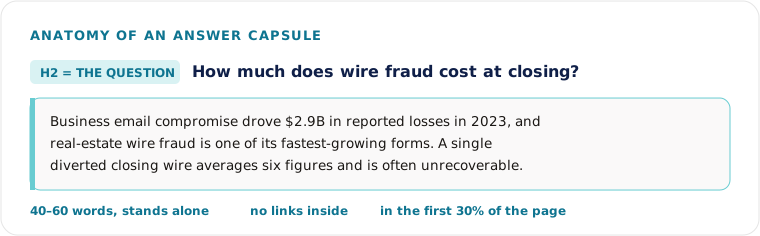
Placement matters too. Kevin Indig’s analysis of 1.2 million ChatGPT citations found 44.2% of them come from the first 30% of a page (Ahrefs). Bury your best answer under 800 words of preamble and you’ve hidden it from the model. Front-load it.
A few formatting habits make chunks easier to extract:
- Write headings as the actual questions people ask, then answer immediately underneath
- Use short paragraphs, one idea each, so a clean chunk exists to lift
- Put comparable facts in tables (pricing, features, specs). Models pull tabular data cleanly and quote it readily
- Keep sentences plain and declarative. A hedge-filled, clause-stacked sentence is hard to extract as a standalone fact
The pitfall here is writing for a highlight reel and forgetting the reader. Answer-first formatting is not permission to publish thin content. The model still needs the surrounding depth to trust the page, and your human buyer has to want to keep reading once ChatGPT sends them over. Lead with the answer, then earn the click with the substance underneath it.
3. Clear the technical bar so you’re eligible at all
This step is unglamorous and non-negotiable. None of your content can be cited if the machines feeding ChatGPT can’t reach it, and a few common misconfigurations quietly lock you out.
Start with crawler access. ChatGPT’s systems use bots named OAI-SearchBot and GPTBot. Open your robots.txt and confirm you’re not blocking them. Plenty of sites added blanket AI-bot blocks in 2024 during the “should we let AI train on us” panic, then forgot the setting was there.
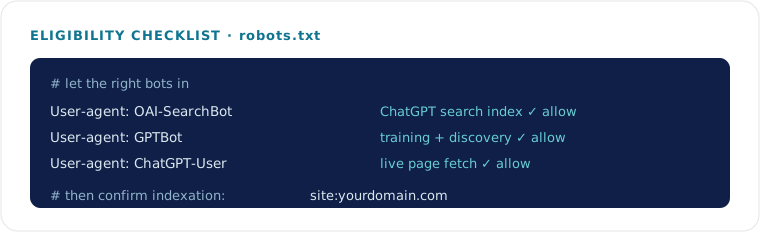
If you want to be found in ChatGPT, those bots need in. Check your CDN too, since Cloudflare and others shipped one-click “block AI bots” toggles that may be on without your knowledge.
Next, make sure you’re indexed everywhere retrieval can pull from. Submit your sitemap in both Google Search Console and Bing Webmaster Tools, and confirm your money pages are indexed in each. ChatGPT draws on search engines and its own crawler, so broad indexation is the highest-ROI technical task in the guide, and it’s easy to overlook when you only ever check Google.
Then remove the things that hide content from a parser:
- Content that only renders with JavaScript can be invisible to crawlers. Make sure your key text is in the HTML, not painted in by a script after load
- Answers trapped inside images or PDFs can’t be read as text. If it matters, it needs to be real on-page text
- Broken or slow pages get dropped. Basic technical health still applies. Our B2B SEO checklist covers the foundations
Now, two things you can skip, because they get oversold. First, llms.txt. It sounds official, and it does nothing today. Google’s John Mueller confirmed no AI system currently uses llms.txt (Search Engine Roundtable), and server-log analysis backs him up. Otterly found only 84 of 62,100 AI-bot visits touched the file, about 0.1%. Skip it until a major provider says otherwise.
Second, don’t expect schema markup to buy you citations. Ahrefs tracked 1,885 pages that added JSON-LD schema against 4,000 that didn’t and found no meaningful citation lift (Ahrefs). Schema still helps search engines understand your pages, so keep it for hygiene, and the citation gains come from elsewhere.
If you’d rather hand off the full technical and entity groundwork, that’s part of what an answer engine optimization engagement covers, though you can get the basics right yourself in an afternoon.
4. Build the off-site brand presence that does the heavy lifting
Here’s the uncomfortable truth about ranking on ChatGPT. Your own website is not where most of the work happens. The strongest signals live off your domain, on the sites ChatGPT already trusts.
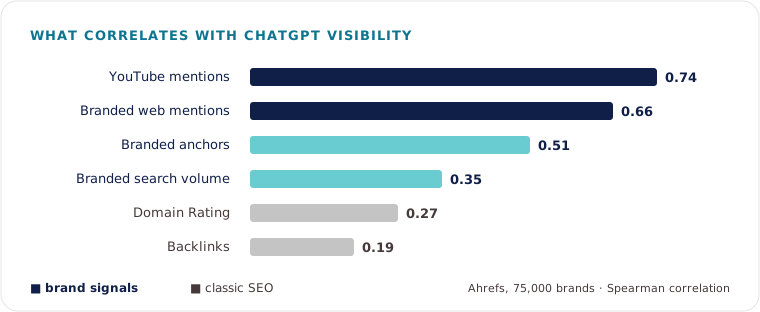
The data is blunt about this. Ahrefs studied 75,000 brands and measured what correlates with ChatGPT visibility. The top factor was mentions on YouTube (a 0.737 correlation), followed by branded web mentions across the internet (0.664). Domain Rating came in at 0.266, and raw backlink counts near 0.19 (Ahrefs).
Read that again: how often people talk about your brand across the web matters roughly three times more than classic link authority. Fishkin reached the same place from his own research, that brands appearing frequently in documents across the web get favored almost regardless of who published them (SparkToro).
So the work is to get your brand named, consistently, in the places that showed up in your step-one source list. A few channels earn their keep:
- YouTube. It’s the top correlate and the one most B2B teams ignore. Get your product named in real videos: your own channel, podcast appearances, partner demos, review videos. Transcripts get indexed and mined
- Reddit and communities. Reddit is one of the most-cited sources across AI answers, though its share moves around, so treat it as high-value and volatile. Be genuinely useful in the subreddits your buyers live in. Overt self-promotion gets removed and can backfire, which is why we run a dedicated Reddit strategy rather than drop-and-run posting
- Review platforms. G2 and Capterra category pages show up constantly as ChatGPT sources. A strong, current profile with recent reviews is a direct line into those answers
- Roundups and “best of” lists. Getting placed on the “best [category] tools” articles that ChatGPT already cites puts you in the answer by proxy
- Digital PR. Editorial mentions in publications the model trusts feed both its training memory and its live retrieval
This is the layer where hiring help pays off fastest, because it’s slow, relationship-heavy work. It’s the core of what we do in a generative engine optimization engagement.
We map the exact buying questions that drive demos for you, find every third-party page ChatGPT cites for those questions, and go earn you placements and brand mentions across them, from listicles and comparison pages to review sites and digital PR. Brand mentions beat backlinks in AI search, so the program is built around getting you talked about on the pages that already win.
That’s how RB2B ended up ranked number one in both Google and ChatGPT for “Leadfeeder alternatives.” We built the bottom-funnel comparison content and earned the third-party citations around it, so when a buyer asks ChatGPT for Leadfeeder alternatives, RB2B is the answer.
The same play lifted Proposify’s AI-search visitors by 91% and their demos by 115%. If you’d rather run it in-house, your step-one source list is your target list. Start with the two or three domains that show up most often for your category and work down.
5. Publish content worth citing
Off-site presence gets you into the candidate pool. Whether the model actually quotes you comes down to whether your page is the best available source for a specific claim. A few content types earn citations far more than a generic blog post.
Original data is the strongest. When you publish a real statistic, a survey result, or a proprietary benchmark, you become the only place that claim can be sourced from. A Princeton study on generative engine optimization tested this and found that adding relevant statistics to a page raised its visibility in AI answers by up to 41%, and adding direct quotations lifted it 28% (Princeton, arXiv).
For pages that weren’t already at the top, the same Princeton research found citing credible sources boosted visibility as much as 115%. One caveat worth knowing: that was a controlled study with a small pool of competing sources, so real-world gains run smaller. The direction is solid even where the exact percentage isn’t a promise.
Comparison content punches above its weight for B2B specifically. “Best [category] tools,” “[you] vs [competitor],” and “[competitor] alternatives” pages match exactly the buying questions people bring to ChatGPT, and the model leans on roundups when it answers them.
This is the content that put RB2B at the top of a buying-intent answer, and it tends to be the fastest path to demos, so it’s where we point clients first. If comparison and alternatives pages are new territory, our ultimate B2B SaaS SEO guide walks through building them.
Two more habits raise your citation odds:
- Keep it fresh. ChatGPT favors recently updated content. AirOps found pages refreshed within the last three months get cited roughly three times as much as stale ones (AirOps). Put a real “last updated” date on cornerstone pages and actually revise them, don’t just change the date
- Show a real author. Content tied to a named expert with genuine credentials and a consistent presence across the web reads as more trustworthy to both search engines and models. Use real bylines, not “admin”
One thing to avoid: chasing citations by spinning up hundreds of thin AI-written pages or faking freshness with cosmetic date changes. Lily Ray has been direct that these tactics can damage your standing in both search and AI, and her reasoning is worth internalizing: “If your content isn’t indexed and ranking in the search engine, it cannot enter the model’s context window” (Lily Ray). Tactics that tank your search visibility take your AI visibility down with them.
6. Track mentions, citations, and share of voice
You built a baseline in step one. This step turns it into a habit, because AI visibility drifts as models update and competitors move. The teams that win treat it like a recurring report they revisit every couple of weeks.
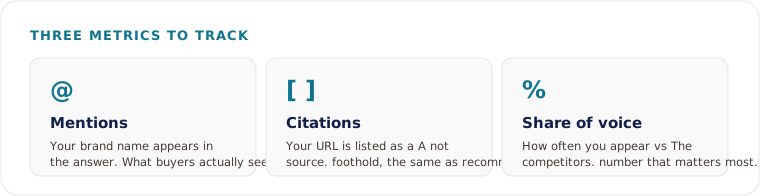
First, get your language straight, because three different things get lumped together as “ranking”:
- Mentions: your brand name appears in the answer. This is what buyers actually see
- Citations: your URL is listed as a source. Useful, and different from being recommended
- Share of voice: across all the category questions you track, how often you appear against your competitors. This is the number that matters most, because it’s relative
The first two come apart more than you’d expect. Semrush found that 62% of AI citations don’t produce a brand mention, meaning your page can be the source feeding the answer while the reader never learns your name (Semrush). So track both. Being cited is a foothold, and being mentioned is the win.
For the actual tracking, you have two routes. The manual one is the spreadsheet from step one, re-run on a fixed cadence with the same prompts so your numbers stay comparable over time. It’s free and it keeps you close to the real answers.
The scaled route is a dedicated tool. Ahrefs Brand Radar, Profound, Semrush’s AI visibility toolkit, Peec, and Otterly all track mentions, citations, and share of voice across ChatGPT and other engines on autopilot. Pricing and fit vary, so check each one’s own site before committing. Whichever you pick, wire up a referral segment in GA4 so you can see the actual sessions ChatGPT sends you, small in volume today and high in intent.
Then close the loop. Every cycle, find the questions where a competitor gained and you slipped, look at the new sources ChatGPT is citing for them, and feed that straight back into steps four and five. That feedback loop, more than any single tactic, is what compounds. If tracking and reporting all this is more than your team can carry, it’s the last pillar of our GEO program for exactly that reason.
ChatGPT ranking FAQs
How does ChatGPT decide which pages to pull from?
It expands your question into several searches, pulls candidate pages from search engines, and increasingly from OpenAI’s own index built by its OAI-SearchBot crawler. Then it ranks those candidates on authority, freshness, and how cleanly they answer the question, and cites only the few that back a specific claim. The takeaway: be broadly indexed and let OpenAI’s crawlers reach you, rather than betting on any single engine.
How long does it take to show up in ChatGPT?
It depends which layer you’re influencing. Once your pages are indexed and you’ve earned some off-site mentions, you can start appearing in live search answers within weeks. The model’s built-in training memory moves much slower and updates whenever OpenAI retrains. Most B2B teams see meaningful movement in AI-search visibility within one to three months of consistent work.
Does llms.txt help you rank in ChatGPT?
No, it doesn’t. Google’s John Mueller confirmed no AI system currently uses llms.txt, and server logs show AI bots almost never request the file. It may matter someday if a major provider adopts it, and as of 2026 it does nothing for your ChatGPT visibility. Put that time into getting indexed and earning brand mentions.
Do backlinks still matter for ranking on ChatGPT?
Less than you’d expect. In Ahrefs’ 75,000-brand study, raw backlink counts correlated with ChatGPT visibility at around 0.19, while branded web mentions came in at 0.664. Links still help your underlying search rankings, which feed retrieval, so they keep their value. But getting your brand talked about across the web moves AI visibility far more than chasing links.
Can a new or small site rank on ChatGPT?
Yes, because ChatGPT rewards brand presence and specific, citable content more than raw authority. A small company that owns a narrow topic with original data and a clean, answer-first page can get cited over a bigger competitor. The catch is you still need off-site mentions and to be indexed, so a brand-new site with no web presence anywhere will struggle until it builds some.
How do I know if ChatGPT is citing my brand?
Run a fixed set of buyer questions through ChatGPT on a schedule and log where you appear, which is the free method. For automated tracking across engines, tools like Ahrefs Brand Radar, Profound, and Semrush’s AI toolkit monitor mentions, citations, and share of voice. Add a GA4 referral segment to catch the actual traffic ChatGPT sends you.
Where to start this week
Getting cited by ChatGPT comes down to the same fundamentals that have always driven B2B growth, aimed at a new surface: be findable, be the clearest answer, and get talked about across the web on the questions your buyers ask. Work the six steps in order, start with the prompt set so you’re measuring instead of guessing, and give it a quarter before you judge the results.
If you’d rather have a team run this for you, getting B2B software cited in ChatGPT, Perplexity, and Google’s AI Overviews is exactly what we do. Book a call and we’ll map the buying questions worth winning for your category and show you where you stand today.